
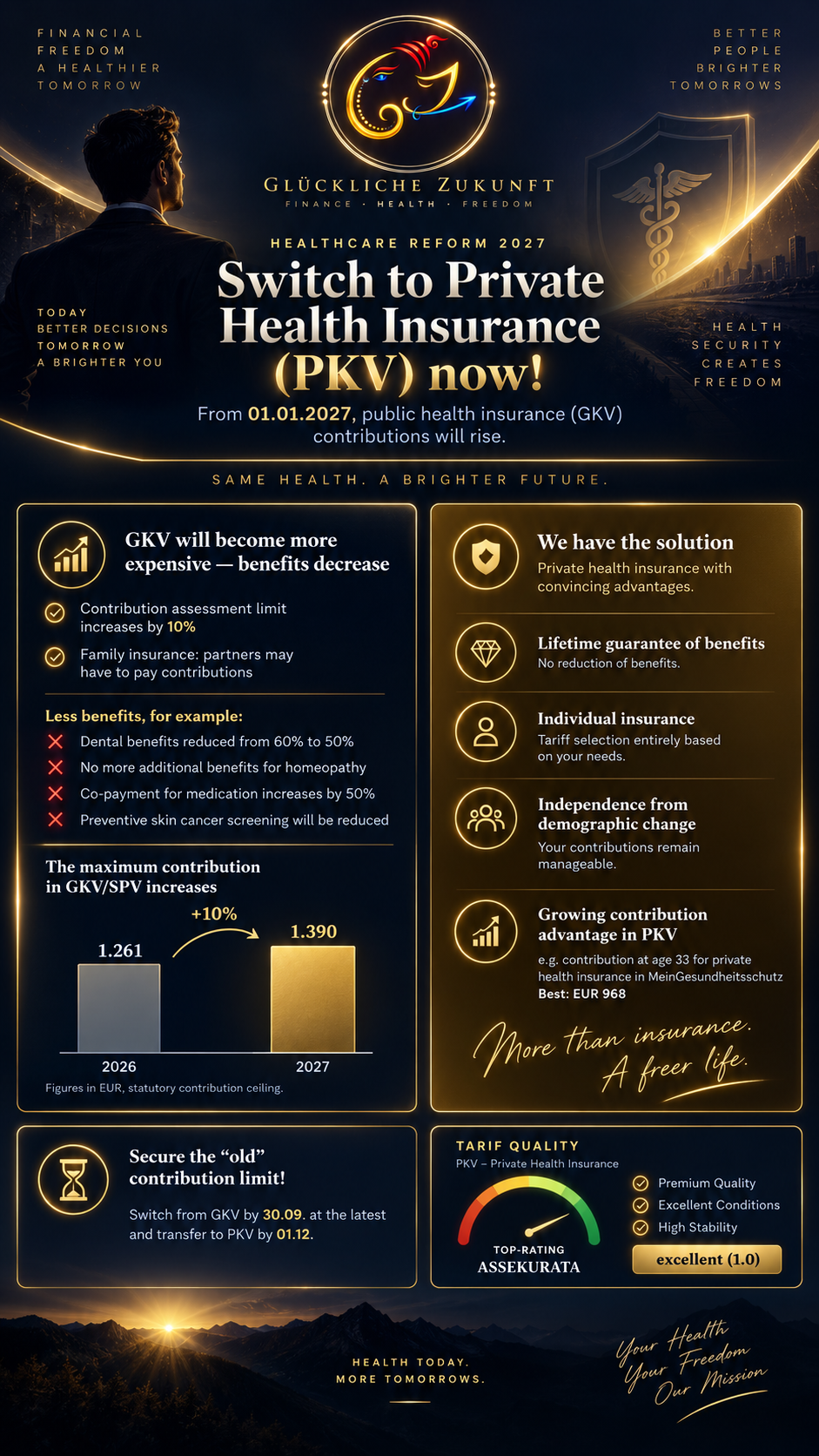
For high-earning employees in Germany, waiting until 2027 could significantly change the options available.
Germany’s health insurance system is entering an important period of change. If you are currently insured through the statutory health insurance system (GKV) and have ever considered switching to private health insurance (PKV), 2026 is a particularly important year to review your situation.
For employees, the decisive figure is the Jahresarbeitsentgeltgrenze (JAEG) — the annual income threshold above which an employee can generally become exempt from compulsory GKV membership and choose between remaining voluntarily insured in the GKV or switching to PKV.
In 2026, this threshold is €77,400 gross per year, or €6,450 per month.
Why does 2027 matter?
The German government has introduced major changes to the financing of statutory health insurance from 2027. Among these measures is an additional extraordinary increase of €300 per month to the relevant income threshold, on top of the usual annual adjustment linked to wage development.
That means employees who are above the PKV eligibility threshold today could potentially find themselves below the new threshold in the future.
For some people, this can make 2026 an important window to evaluate their options rather than automatically postponing the decision.
The exact 2027 social-security thresholds are determined through the annual Social Security Calculation Ordinance, so the final figure should always be checked before making a decision.
What happens if your salary exceeds the threshold?
If an employee’s regular annual salary exceeds the applicable JAEG, they may become exempt from compulsory statutory health insurance.
In that situation, there are generally two options:
remain voluntarily insured in the GKV, or
switch to a private health insurance plan.
For employees whose compulsory GKV membership ends because their salary exceeds the threshold, the change normally takes effect at the end of the calendar year only if their expected income also exceeds the applicable threshold for the following year.
This is exactly why looking at the situation before year-end can be important.
But PKV is not automatically better
A switch should never be based only on the monthly contribution.
PKV and GKV are fundamentally different systems.
Depending on the selected tariff, private insurance can offer advantages such as:
broader outpatient and hospital benefits,
access to higher reimbursement levels,
private or semi-private hospital accommodation,
specialist treatment options,
individually selected dental benefits,
benefits that are contractually defined rather than linked directly to the statutory GKV benefit catalogue.
However, the right solution depends heavily on your personal circumstances.
Age, health history, family plans, children, spouse, income development and long-term retirement planning all matter.
And there is another important point: returning from PKV to GKV later is not always easy. German law deliberately places restrictions on moving back into statutory insurance, particularly at older ages.
What is changing in the GKV?
Germany is reforming statutory health insurance because healthcare expenditure has been rising significantly faster than contribution income.
The Federal Ministry of Health reported that GKV expenditure continued to grow strongly in 2026. The reform package is intended to stabilize the system from 2027.
Among the measures already adopted are changes to financing and cost-sharing. For example, statutory co-payment amounts are scheduled to increase by 50%, while the government is simultaneously trying to prevent a sharp rise in the average supplementary contribution rate.
So the story is not simply that “GKV is becoming bad.”
The more relevant question is:
Which system fits your personal and financial situation better over the next 10, 20 or 30 years?
Who should review their situation now?
A review is particularly worthwhile if you:
earn close to or above the €77,400 annual income threshold,
recently received a salary increase,
expect your income to rise during 2026,
are currently voluntarily insured in the GKV,
have previously considered PKV but postponed the decision,
are young and healthy and want to understand your long-term options,
want stronger hospital, dental or specialist benefits,
or simply want to know what the 2027 reforms could mean for you.
Timing matters — but so does proper planning
There is no universal answer to the question:
“Should I switch to PKV?”
For one person, PKV can be an excellent long-term solution. For another, remaining in the GKV may be clearly preferable.
That decision should include more than just today’s premium.
A proper comparison should consider:
Current contribution → future contribution development → family situation → benefits → retirement → flexibility → health history.
That is why I recommend reviewing the numbers before making the decision, rather than switching only because of a headline or waiting until the rules have already changed.
Your situation can be checked individually
If you are working in Germany and currently insured through the GKV, I can help you determine:
whether you are eligible for PKV,
whether a switch in 2026 is possible,
how GKV and PKV compare for your personal situation,
what benefits actually matter,
what the financial impact could be,
and what you should consider for your family and retirement.
Don’t switch because somebody tells you PKV is better.
Switch only if the numbers, benefits and long-term strategy make sense for you.
But if you are considering it, 2026 is a year in which it makes sense to check your options sooner rather than later.
Glückliche Zukunft
Inclusion · Transparency · Prosperity
📩 info@gzukunft.de
🌐 www.gzukunft.de
📱 @financewithgz