What would you like retirement to look like? More time with family, the freedom to travel, or simply knowing that everyday expenses are covered?
Before choosing an investment, it helps to put a number on that picture. Compare the income you would like with the pension and savings you already expect to have. That gives your retirement planning a purpose—and makes it easier to assess new options such as the Altersvorsorgedepot, or AVD.
What is the AVD?
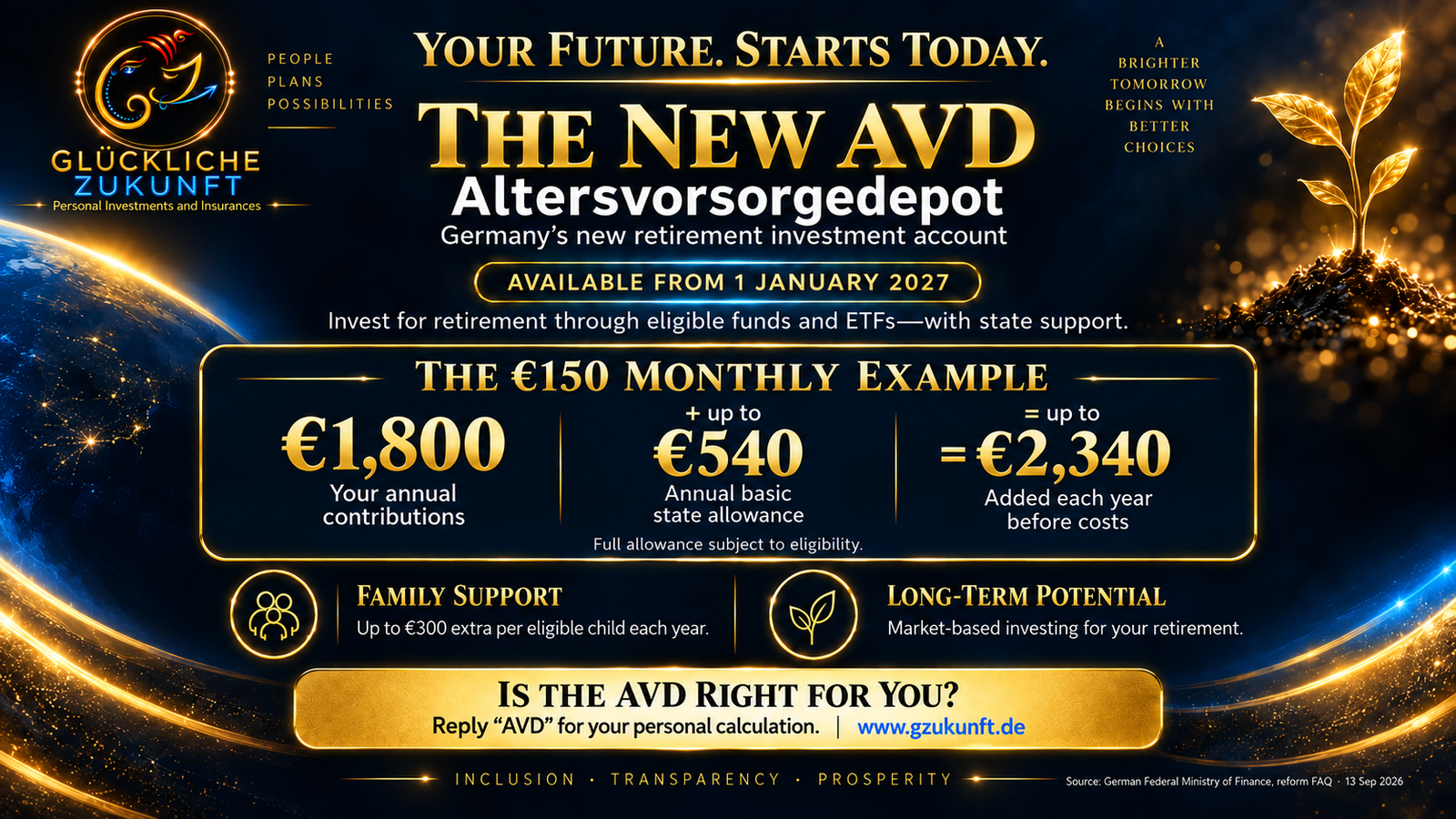
Germany’s pension reform introduces a subsidised retirement investment account without a capital guarantee, opening the door to eligible funds and ETFs. New products can be offered from 1 January 2027. Guarantee products remain available separately. The reform has already entered into force; product implementation follows in 2027. Federal Government overview
For anyone considering an AVD, the useful question is how it would fit alongside existing savings, rather than how attractive its headline sounds.
What could €150 per month look like?
Under the new allowance formula, the state adds 50 cents per euro on the first €360 contributed annually, then 25 cents per euro on the next €1,440. For an eligible saver contributing €150 monthly, this gives:
Annual contribution calculation------------------------Amount
Your contributions:-----------------------------------€150 × 12 = €1,800
Basic state allowance, subject to eligibility: -----------€540
Combined annual amount before costs:---------------€2,340
Eligible families can also receive up to €300 per child annually. Existing Riester contracts can continue; switching is voluntary.
The €2,340 figure describes contributions plus allowance. It is not an investment return or a promised future balance. When comparing offers, ask to see what happens after all charges and under different investment outcomes.
How do you receive the money in retirement?
Payouts generally begin between ages 65 and 70, with specified early-pension exceptions. You can choose lifelong pension payments or a payout plan lasting at least to age 85. A fixed-term plan stops paying when it ends. BMF payout guidance
Think about the expenses your other retirement income will cover. Would you depend on this money for essentials throughout your life, or would it supplement income already covering those essentials? That distinction is worth discussing before selecting a payout arrangement.
Can you take 30% upfront?
Up to 30% can be withdrawn as a lump sum at payout start. The remaining capital funds the pension or payout plan. Taking that lump sum does not shorten the plan’s minimum duration to age 85. BMF withdrawal rules
For example, €100,000 would allow up to €30,000 upfront, leaving €70,000 for ongoing payments, before tax. Applying the age-85 rule gives:
Payout starts at ------------------------Minimum fixed-term duration
65 -------------------------------------------------20 years
67 -------------------------------------------------18 years
70 -------------------------------------------------15 years
These are illustrations, not product quotations. Consider what you would use the lump sum for and how a smaller remaining balance would affect your monthly budget.
What should you check before deciding?
Investment values can fall, and costs reduce the outcome. Payments attributable to subsidised contributions are fully taxable. Non-permitted withdrawals can trigger subsidy repayment. For expats, retirement residence outside the EU/EEA can also trigger repayment obligations. BMF tax and withdrawal guidance
Prepare for a consultation by bringing your pension information, existing contracts and a realistic monthly budget. Useful questions include:
What retirement income am I aiming for, in today’s purchasing power?
How much can I commit while keeping a separate emergency reserve?
How would I respond to a substantial fall in my investment value?
What are the total costs of each offer?
What would I give up by changing an existing contract?
Where do I expect to live in retirement?
If you may move abroad, make your destination part of the discussion from the beginning. Country-specific tax advice may be needed before making a commitment.
Your future starts with a clear plan
At Glückliche Zukunft, we believe financial decisions should be understandable and connected to the life you want to build. A useful consultation begins with your goals, budget and existing arrangements.
Would you like to explore whether the AVD fits your retirement plans? Contact GZ with the keyword “AVD” to arrange a personal discussion.
Explore Glückliche Zukunft
Inclusion · Transparency · Prosperity
General information, not an individual investment or tax recommendation. Eligibility, available products and contract terms must be checked for your circumstances. Information checked on 17 September 2026.